
AIoT Solutions for Rare Earth & Critical Mineral Operations
RareMetal AI develops enterprise AI and IoT software that improves operational visibility across the complete rare earth and critical mineral value chain, from exploration support and ore extraction through mineral beneficiation, hydrometallurgical processing, solvent extraction, rare earth separation, oxide production, refining, warehousing, and export logistics.
The software emphasizes identification and location technologies that help mining organizations accurately locate personnel, verify site access, identify mobile equipment, reconcile stockpile inventory, coordinate production assets, and maintain digital chain of custody records for strategic minerals. Rather than focusing primarily on industrial sensing, the solution prioritizes enterprise identification, asset visibility, workforce accountability, and operational coordination using RFID, BLE, Ultra-Wideband (UWB), GPS, LoRaWAN, Private LTE, 5G, industrial Wi-Fi, and edge computing.
Rare earth and critical mineral production presents operational challenges that differ significantly from conventional mining. Production commonly involves multiple extraction methods, complex beneficiation circuits, hydrometallurgical processing, solvent extraction stages, ion exchange systems, precipitation, calcination, refining, and high-value product handling. Materials such as bastnäsite, monazite, xenotime, ionic adsorption clay ores, mixed rare earth concentrate (MREC), mixed rare earth carbonate, neodymium-praseodymium (NdPr) oxide, dysprosium oxide, terbium oxide, yttrium oxide, scandium oxide, lithium-bearing minerals, graphite concentrates, cobalt intermediates, and other strategic mineral products require accurate operational tracking throughout processing and distribution.
AI and IoT enables mining organizations to improve operational awareness, strengthen workforce accountability, increase equipment utilization, reduce manual recordkeeping, improve inventory accuracy, and provide executive decision-makers with actionable operational information across geographically distributed mining and mineral processing facilities.
Supporting the Complete Rare Earth and Critical Mineral Production Lifecycle
Rare earth elements and critical minerals are fundamental to electric vehicle motors, permanent magnets, offshore wind turbines, utility-scale battery energy storage systems, semiconductor manufacturing, defense systems, aerospace technologies, telecommunications infrastructure, robotics, industrial automation, and advanced medical equipment. Increasing global demand has placed greater emphasis on operational efficiency, responsible sourcing, material provenance, and production transparency throughout mining and refining operations.
Unlike many traditional mining operations, rare earth production typically involves numerous interconnected processing stages before producing commercially usable oxides or refined materials. Operational visibility must therefore extend beyond extraction activities into downstream processing and logistics.
RareMetal AI supports identification and location workflows throughout:
- Geological exploration support
- Open-pit mining
- Underground mining
- Drill and blast preparation
- Ore hauling
- Primary crushing
- Secondary crushing
- Grinding and milling
- Beneficiation
- Froth flotation
- Magnetic separation
- Gravity separation
- Ore stockpile management
- Hydrometallurgical cracking
- Acid leaching
- Alkaline leaching
- Solvent extraction (SX)
- Ion exchange processing
- Precipitation
- Filtration
- Calcination
- Rare earth oxide production
- Critical mineral refining
- Concentrate storage
- Warehouse operations
- Export staging
- Port logistics
- Material distribution
Each operational stage introduces movement of personnel, mobile equipment, maintenance assets, production materials, laboratory samples, intermediate products, and finished inventory. Accurate identification throughout these activities improves operational coordination while reducing unnecessary delays and manual administrative effort.
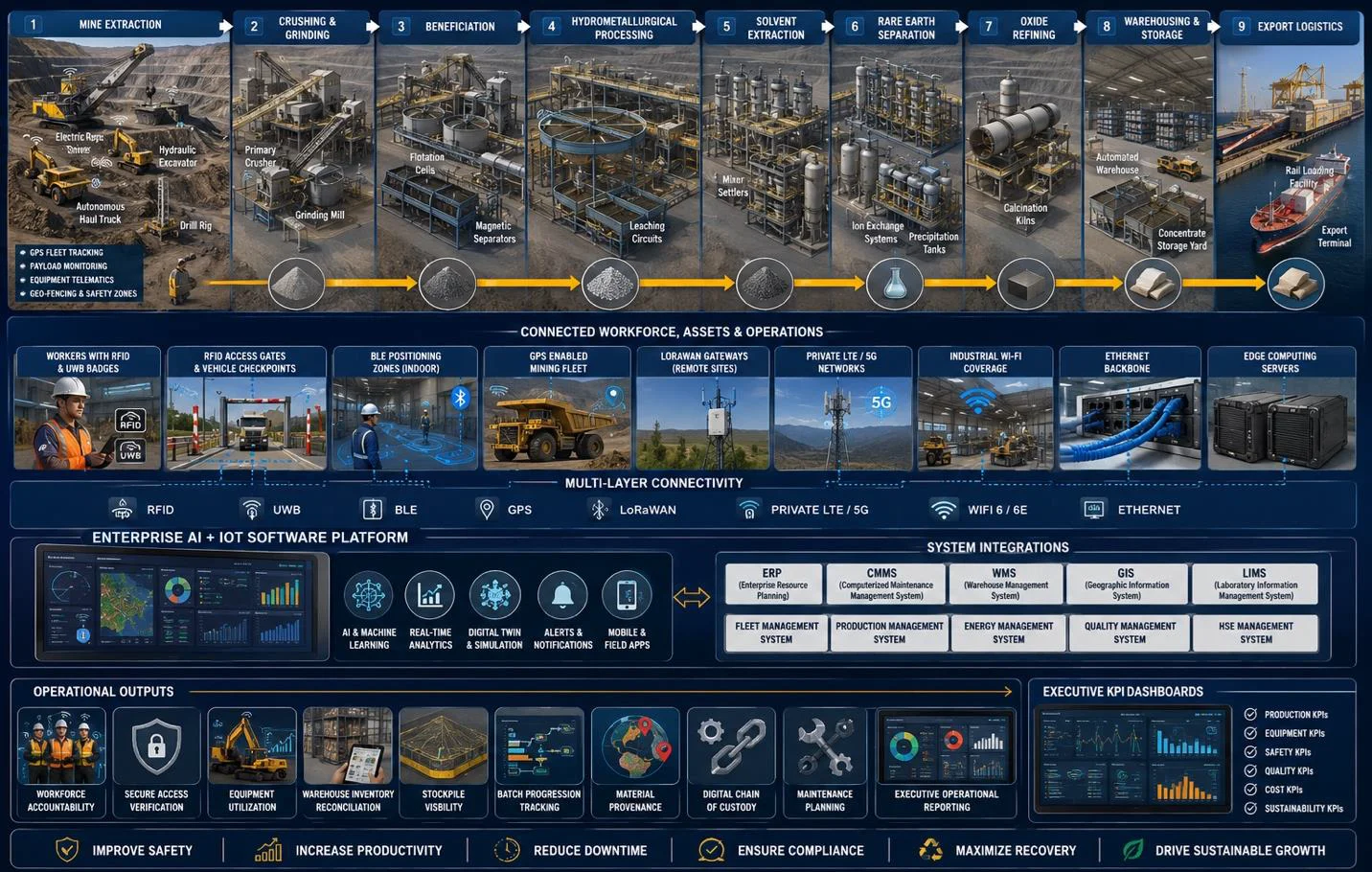
AI + IoT-Enabled Rare Earth and Critical Mineral Production Value Chain with Enterprise Asset Tracking and Operational Intelligence
This enterprise illustration presents the complete rare earth and critical mineral production lifecycle, from mine extraction and mineral processing through hydrometallurgical refining, oxide production, warehousing, and export logistics. It demonstrates how AI, RFID, UWB, GPS, BLE, LoRaWAN, Private LTE/5G, and edge computing integrate with enterprise software to improve workforce visibility, asset tracking, inventory management, operational efficiency, maintenance planning, and executive decision-making.
AI and IoT Specifically Designed for Rare Earth and Critical Mineral Facilities
AIoT, commonly referred to as AI and IoT, combines AI with connected industrial identification technologies, wireless communications, enterprise software, and edge computing to improve operational decision-making.
Within rare earth and critical mineral production, AI and IoT focuses primarily on identification and location rather than traditional industrial sensing. The objective is to determine who is present, what equipment is operating, where critical assets are located, which inventory is available, how production materials move through processing, and whether authorized personnel are accessing controlled operational areas.
RareMetal AI combines multiple complementary technologies to address different operational requirements throughout extraction, processing, refining, warehousing, and logistics operations.
Supported identification technologies include:
- Passive RFID
- Active RFID
- BLE location services
- Ultra-Wideband (UWB)
- GPS fleet positioning
- LoRaWAN communications
- Private LTE
- 5G connectivity
- Industrial Wi-Fi
- Edge computing
- AI-assisted operational analytics
Rather than relying on a single wireless technology, deployments are engineered according to operational workflows, infrastructure availability, positioning accuracy requirements, environmental conditions, and enterprise integration objectives.
Core AI and IoT Capabilities for Strategic Mineral Operations
RareMetal AI combines enterprise AI software with industrial identification technologies to improve visibility across the complete operational lifecycle.
Core capabilities include:
Each capability is designed to exchange operational information with existing ERP, CMMS, WMS, GIS, Laboratory Information Management Systems (LIMS), fleet management software, production scheduling software, maintenance planning systems, and business reporting applications.
Why Operational Visibility Has Become Mission-Critical
Growing worldwide demand for rare earth elements and critical minerals has increased expectations for production efficiency, responsible sourcing, regulatory compliance, inventory accuracy, cybersecurity, and operational transparency. Mining organizations are expected to manage increasingly complex operations while maintaining accurate records across extraction sites, processing plants, warehouses, refining facilities, and export logistics.
AI-assisted identification and location technologies help organizations address these challenges by improving operational visibility throughout the production lifecycle.
Operational benefits include:
- Faster personnel accountability
- Improved emergency preparedness
- Better workforce deployment
- Reduced equipment search time
- Higher fleet utilization
- Improved maintenance scheduling
- More accurate warehouse inventory
- Better stockpile reconciliation
- Improved production planning
- Enhanced shipment verification
- Stronger material provenance documentation
- Digital chain of custody records
- Improved executive reporting
- Better regulatory audit readiness
- Increased operational efficiency across distributed mining operations
These improvements become increasingly valuable as organizations expand production capacity, commission additional separation facilities, modernize refining operations, or manage multiple geographically distributed mining sites.
Industrial Experience Supporting Enterprise AI and IoT Deployments
RareMetal AI has been developed using practical industrial deployment experience gained through thousands of enterprise AI and IoT implementations. Created within Aperture Venture Studio with support from GAO, the company benefits from more than two decades of industrial IoT experience supporting organizations across complex industrial sectors.
Significant investments in research and development, rigorous quality assurance procedures, and engineering-led implementation methodologies contribute to reliable enterprise software designed for demanding industrial environments. The engineering organization includes Ph.D. professionals from leading universities together with experienced solution architects specializing in industrial wireless communications, enterprise software integration, RFID systems, location technologies, and operational analytics.
This experience has supported thousands of industrial projects for Fortune 500 manufacturers, globally recognized research organizations, prestigious universities, and government agencies throughout the United States and Canada, providing practical expertise that directly benefits rare earth and critical mineral operations.
AI Functions for AIoT-Enabled Rare Earth & Critical Mineral Operations
Rare earth and critical mineral operations involve complex material movement across extraction sites, beneficiation plants, hydrometallurgical processing facilities, solvent extraction circuits, oxide production lines, refining plants, maintenance workshops, warehouses, concentrate storage yards, and export terminals. Personnel, mobile mining equipment, maintenance assets, laboratory samples, intermediate products, and finished rare earth oxides continuously move throughout these operational environments.
Unlike conventional production facilities, rare earth processing requires strict coordination between mining, mineral processing, metallurgy, quality assurance, logistics, and inventory management. Accurate identification and location information therefore becomes an operational requirement rather than simply an efficiency improvement.
RareMetal AI combines AI and IoT software with RFID, BLE, Ultra-Wideband (UWB), GPS, LoRaWAN, Private LTE, 5G, industrial Wi-Fi, and edge computing to improve operational visibility throughout the production lifecycle. AI analyzes identification events, historical operational records, workforce movement, equipment utilization, inventory transactions, and production workflows to generate operational insights that support planning, scheduling, maintenance, compliance, and executive decision-making.
The following AI-enabled operational capabilities have been designed specifically for rare earth mining, critical mineral extraction, beneficiation, hydrometallurgical processing, solvent extraction, rare earth separation, oxide refining, warehousing, and export logistics.
Personnel Location Analytics
Personnel accountability is one of the highest priorities across rare earth and critical mineral operations. Employees, contractors, blasting crews, metallurgists, geologists, maintenance technicians, laboratory analysts, survey teams, and emergency response personnel frequently move among active mining areas, processing facilities, maintenance workshops, reagent storage buildings, laboratories, warehouses, and administrative offices.
Traditional paper-based accountability methods or manual radio check-ins provide limited operational awareness and become increasingly difficult as mining operations expand across multiple production sites.
AI-assisted personnel location software continuously analyzes identification events generated by RFID, BLE, or UWB technologies to provide supervisors with accurate workforce visibility while maintaining historical operational records.
Primary capabilities include:
- Underground miner location visibility
- Surface workforce accountability
- Contractor location management
- Maintenance technician coordination
- Laboratory personnel identification
- Emergency evacuation reporting
- Muster point verification
- Workforce utilization analysis
- Shift transition accountability
- Historical movement reporting
- Operational route analysis
- Workforce deployment optimization
Rather than simply displaying personnel locations, AI software identifies recurring movement patterns, travel bottlenecks, delayed response times, congestion around production areas, and operational inefficiencies that can be addressed through improved workforce planning.
Underground Rare Earth Miner Location Analytics
Underground critical mineral operations include decline ramps, shaft stations, production headings, ore passes, ventilation districts, conveyor galleries, electrical substations, pumping stations, refuge chambers, maintenance bays, and loading points where personnel visibility is essential for operational coordination.
RFID, BLE, and UWB technologies enable accurate workforce accountability in environments where satellite positioning technologies are unavailable. AI software correlates personnel location histories with production schedules, maintenance activities, and work assignments to improve operational awareness during routine operations and emergency response situations.
Strategic Mineral Lone Worker Safety Analytics
Electrical technicians, instrumentation engineers, geological survey teams, laboratory specialists, environmental personnel, and maintenance crews occasionally perform work independently in remote operational areas.
AI software evaluates historical movement behavior and identification events to recognize unusual inactivity, unexpected route deviations, missed reporting intervals, or extended occupancy within designated work zones. These operational indicators assist supervisors in determining whether additional investigation or communication may be required.
Rare Earth Workforce Movement Pattern Analysis
Historical workforce movement data provides valuable operational insight beyond immediate personnel visibility.
Machine learning algorithms evaluate:
- Frequently traveled routes
- Travel duration between work areas
- Shift transition efficiency
- Operational congestion
- Workforce distribution
- Area occupancy
- Maintenance travel frequency
- Contractor deployment
- Production support activities
These operational analytics assist mining organizations in improving workforce allocation while minimizing unnecessary movement across large production facilities.
Site Access Verification
Rare earth mining and processing facilities contain numerous operational areas with different security, operational, and regulatory requirements. Controlled access is commonly required for solvent extraction buildings, hydrometallurgical processing areas, reagent storage facilities, explosive magazines, high-voltage substations, laboratory facilities, rare earth oxide packaging areas, warehouse operations, control rooms, maintenance workshops, and export staging facilities.
AI-assisted access verification improves operational security by validating personnel authorization before entry while maintaining complete electronic access records.
Core capabilities include:
- Role-based authorization
- Employee credential verification
- Contractor qualification validation
- Contractor qualifications
- Safety certifications
- Site inductions
- Work authorizations
- Access permissions
- Temporary credentials
- Visitor approvals
This reduces administrative effort while improving workforce accountability throughout project execution.
Strategic Mineral Access Anomaly Detection
AI evaluates historical access records to recognize operational anomalies such as:
- Unexpected entry times
- Unauthorized area transitions
- Repeated denied access attempts
- Abnormal occupancy duration
- Irregular shift activity
- Unusual contractor movement
These operational insights support security personnel without interrupting routine production activities.
Asset Location Analytics
Rare earth and critical mineral operations depend on expensive mobile mining equipment, specialized processing assets, laboratory instruments, maintenance equipment, mobile workshops, and warehouse resources distributed across extensive industrial sites.
Locating these assets quickly reduces operational delays and improves equipment availability.
Assets commonly managed include:
- Hydraulic excavators
- Electric rope shovels
- Haul trucks
- Blast hole drill rigs
- Wheel loaders
- Bulldozers
- Water trucks
- Fuel trucks
- Service vehicles
- Forklifts
- Mobile cranes
- Portable compressors
- Welding equipment
- Calibration instruments
- Laboratory analyzers
- Survey equipment
- Maintenance tool assemblies
- Replacement pump skids
- Electrical components
- Mobile generators
RFID, BLE, GPS, and cellular communications provide continuous identification of these operational resources while AI software evaluates utilization trends and equipment movement history.
Rare Earth Mobile Equipment Location Analytics
Large mining concessions may extend across several square miles, making manual equipment location inefficient.
GPS, RFID, and cellular technologies provide continuous visibility for mobile mining fleets operating among:
- Active pit areas
- Waste dumps
- Ore stockpiles
- Maintenance facilities
- Fuel stations
- Crushing plants
- Haul roads
- Contractor work zones
AI software analyzes travel history, idle periods, dispatch activity, equipment availability, and route efficiency to support operational planning and fleet optimization.
Critical Mineral Processing Equipment Utilization Analytics
Beneficiation and refining facilities contain thousands of operational assets including crushers, SAG mills, ball mills, flotation cells, magnetic separators, hydrocyclones, thickeners, pumps, filters, solvent extraction mixer-settlers, precipitation tanks, calcination kilns, conveyors, and packaging equipment.
AI-assisted utilization analysis identifies operational trends including:
- Equipment usage frequency
- Maintenance intervals
- Idle equipment
- Resource allocation
- Equipment availability
- Operational bottlenecks
These insights support maintenance planning and production scheduling.
Strategic Mining Machinery Movement Prediction
Historical identification records allow AI models to estimate future equipment availability based on maintenance schedules, production plans, utilization history, operational demand, and historical movement patterns.
Predictive movement analysis assists dispatch personnel by improving equipment allocation during changing production conditions.
Rare Earth Separation Plant Asset Tracking
Separation plants contain thousands of movable operational assets including laboratory instruments, portable analyzers, maintenance carts, pumps, valves, piping assemblies, reagent containers, calibration equipment, lifting devices, portable tools, and inspection equipment.
Digital identification reduces manual search time while improving maintenance coordination and asset accountability.
Stockpile Inventory Analytics
Inventory management extends well beyond warehouse shelving throughout rare earth operations.
Organizations routinely manage:
- Run-of-mine ore
- Crushed ore
- Beneficiated concentrate
- Mixed rare earth concentrate (MREC)
- Mixed rare earth carbonate
- Rare earth oxides
- Reagents
- Spare parts
- Maintenance inventory
- Packaging materials
- Laboratory supplies
- Finished export products
Accurate inventory identification improves production planning, warehouse efficiency, shipment preparation, and financial reporting.
Primary inventory capabilities include:
- Ore stockpile identification
- Inventory reconciliation
- Concentrate inventory visibility
- Warehouse inventory management
- Spare parts tracking
- Finished product management
- Material transfer documentation
- Export inventory verification
- Storage location optimization
- Digital inventory reporting
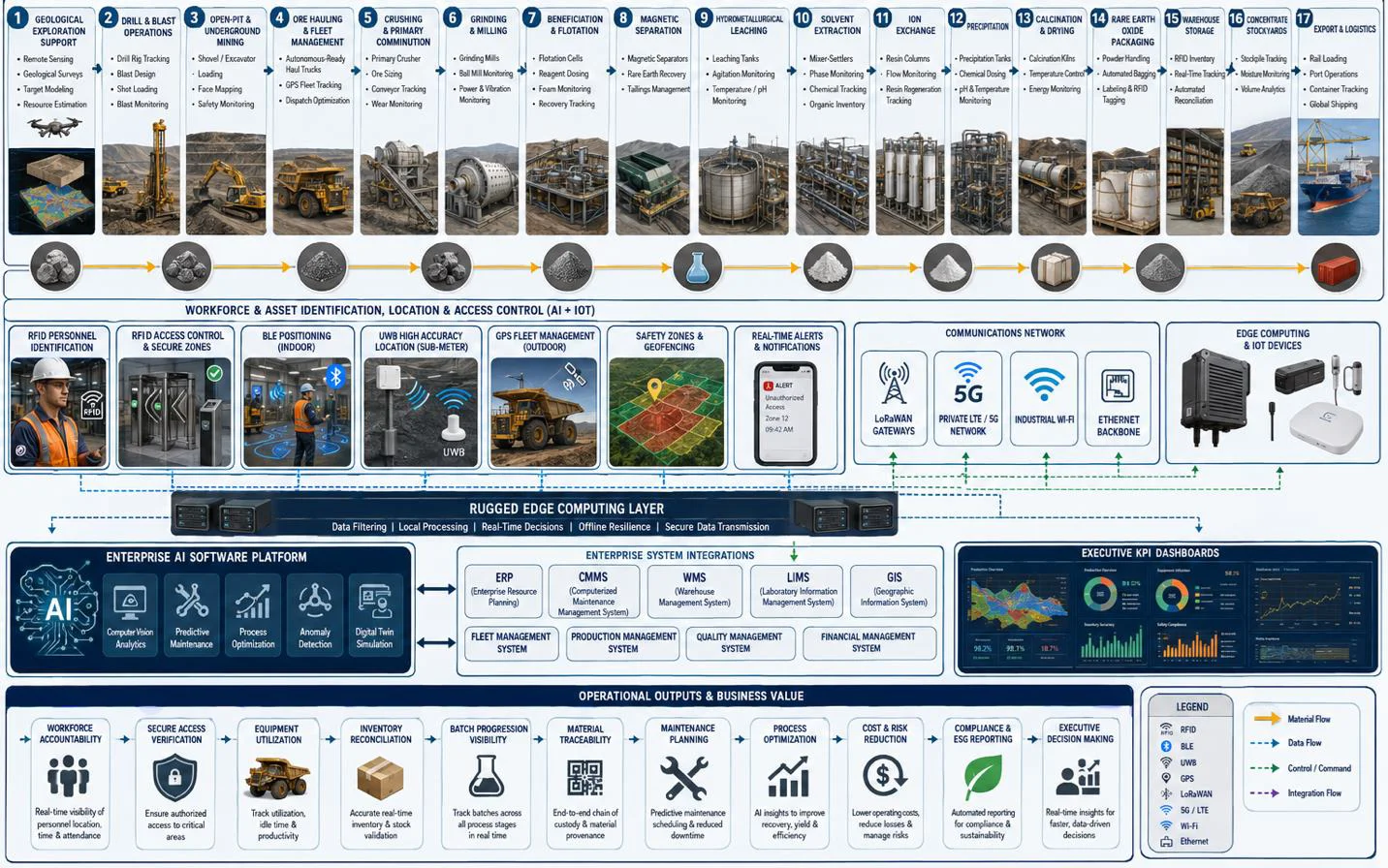
Enterprise AI + IoT Operational Workflow for Rare Earth and Critical Mineral Production
This enterprise workflow diagram illustrates how AI-powered identification, location, and industrial IoT technologies support the complete rare earth and critical mineral production lifecycle—from geological exploration and mining through mineral processing, refining, warehousing, and export logistics. It demonstrates the integration of RFID, BLE, UWB, GPS, edge computing, and enterprise business systems to deliver workforce accountability, secure access, equipment visibility, inventory reconciliation, material traceability, predictive maintenance, and executive operational intelligence across the entire mining value chain.
Rare Earth Ore Inventory Analytics
Mining operations commonly maintain multiple ore stockpiles based on mineral grade, rare earth element distribution, processing sequence, blending requirements, moisture content, and production schedules.
RFID-assisted inventory identification supports accurate stockpile reconciliation while reducing manual inventory recording.
Critical Mineral Concentrate Stockpile Volume Forecasting
AI evaluates production history, inventory movements, shipment schedules, and historical throughput to estimate future concentrate inventory availability.
These forecasts assist processing facilities with production scheduling, warehouse planning, and downstream refining operations.
Strategic Mineral Oxide Inventory Optimization
High-value refined materials such as NdPr oxide, dysprosium oxide, terbium oxide, scandium oxide, yttrium oxide, and other separated rare earth oxides require accurate inventory management before shipment to battery manufacturers, permanent magnet producers, semiconductor manufacturers, aerospace suppliers, and defense contractors.
AI software assists warehouse personnel by improving inventory visibility while reducing reconciliation discrepancies.
Rare Earth Inventory Reconciliation Analytics
Inventory reconciliation software compares enterprise inventory transactions with RFID identification events recorded throughout mining operations.
Automated reconciliation helps organizations:
- Reduce inventory discrepancies
- Improve warehouse accuracy
- Identify missing inventory
- Verify shipment preparation
- Improve production reporting
- Support financial reconciliation
- Improve audit readiness
These capabilities contribute to greater operational confidence across geographically distributed mining, processing, refining, and warehouse operations.
IoT Software for AIoT-Enabled Rare Earth & Critical Mineral Facilities
Rare earth and critical mineral operations depend on multiple enterprise software systems to coordinate extraction, beneficiation, hydrometallurgical processing, solvent extraction, refining, warehousing, maintenance, laboratory operations, logistics, and regulatory reporting. AI and IoT software complements these systems by providing accurate identification and location information that improves operational visibility without disrupting established production workflows.
Rather than functioning as standalone applications, RareMetal AI software exchanges operational information with enterprise resource planning (ERP), computerized maintenance management systems (CMMS), warehouse management systems (WMS), laboratory information management systems (LIMS), geographic information systems (GIS), fleet management software, production execution software, security management software, and business reporting applications.
This integrated approach enables mining organizations to make operational decisions using trusted identification data collected throughout extraction sites, processing facilities, warehouses, and logistics operations.
IoT Hardware Technologies for AIoT-Enabled Rare Earth & Critical Minerals
Identification and location technologies form the physical foundation of enterprise AI and IoT deployments within rare earth mining, beneficiation plants, hydrometallurgical facilities, solvent extraction circuits, oxide refineries, maintenance workshops, warehouses, concentrate storage yards, and export terminals. Because no single wireless technology satisfies every operational requirement, successful deployments combine complementary technologies based on positioning accuracy, coverage area, environmental conditions, infrastructure availability, and operational workflows.
AIoT Integration for Rare Earth & Critical Mineral Operations
Rare earth and critical mineral operations rely on a broad range of operational software throughout exploration support, extraction, mineral processing, solvent extraction, hydrometallurgical processing, oxide refining, warehouse management, laboratory operations, maintenance, logistics, and executive reporting. The value of AI and IoT increases significantly when identification and location information is exchanged automatically with these existing enterprise applications rather than being isolated within independent systems.
RareMetal AI is designed to integrate with established industrial software while preserving existing operational workflows. This approach enables organizations to enhance operational visibility without replacing critical production systems or disrupting ongoing mining and mineral processing activities.
Why Choose RareMetal AI
RareMetal AI develops enterprise AI and IoT solutions specifically for the operational requirements of rare earth and critical mineral production rather than adapting generic manufacturing or warehouse software to mining environments. Every deployment is designed around identification, location visibility, workforce accountability, equipment utilization, inventory governance, and operational coordination across extraction, beneficiation, separation, refining, warehousing, and export logistics.
Key advantages include:
- Specialized experience supporting rare earth and critical mineral operations
- Enterprise focus on identification and location technologies
- Support for RFID, BLE, UWB, GPS, LoRaWAN, Private LTE, 5G, industrial Wi-Fi, and edge computing
- Integration with existing ERP, CMMS, WMS, GIS, LIMS, and production software
- Cloud, on-premises, and hybrid deployment options
- Multi-site operational management
- Scalable software for expanding mining enterprises
- Enterprise-grade cybersecurity practices
- Engineering-led implementation methodology
- Remote and onsite technical support
- Long-term software lifecycle support
- Flexible integration with existing operational infrastructure
RareMetal AI was created within Aperture Venture Studio with support from GAO and is built upon more than two decades of industrial IoT experience. Extensive investments in research and development, structured quality assurance processes, and engineering expertise contribute to enterprise software that addresses the practical challenges of industrial identification and operational visibility.
The engineering organization includes Ph.D. professionals, experienced industrial solution architects, software engineers, wireless communication specialists, and enterprise integration experts. Collectively, this experience has supported thousands of industrial AI and IoT projects for Fortune 500 companies, leading research organizations, prestigious universities, and government agencies across the United States and Canada.
Advancing Rare Earth and Critical Mineral Operations with Enterprise AI & IoT
RareMetal AI delivers enterprise AI and IoT software focused on identification and location solutions for rare earth and critical mineral operations. Using RFID, BLE, UWB, GPS, LoRaWAN, Private LTE, 5G, industrial Wi-Fi, and edge computing, the software improves personnel accountability, secure access verification, equipment visibility, fleet coordination, inventory reconciliation, production workflow visibility, and digital chain of custody throughout extraction, beneficiation, hydrometallurgical processing, solvent extraction, oxide refining, warehousing, and export logistics.
Designed specifically for the operational characteristics of strategic mineral production, the solution integrates with established enterprise software while supporting cloud, on-premises, and hybrid deployments. The result is greater operational transparency, improved resource utilization, enhanced regulatory readiness, and more informed decision-making across the complete rare earth and critical mineral value chain.
Transform Your Operations
Whether your organization operates a rare earth mine, critical mineral extraction site, beneficiation facility, solvent extraction plant, oxide refinery, warehouse, concentrate storage yard, or multi-site production network, RareMetal AI can help improve operational visibility through enterprise AI and IoT identification and location solutions.
Our engineering specialists can assist with:
- Operational workflow assessments
- Identification technology selection
- RFID, BLE, UWB, GPS, and LoRaWAN deployment planning
- Enterprise software integration strategy
- Infrastructure readiness assessments
- Pilot project design
- Multi-site rollout planning
- Cloud, on-premises, and hybrid deployment guidance
- User training
- Long-term technical support
- System expansion planning
- Performance optimization
Contact RareMetal AI to discuss how enterprise AI and IoT identification and location solutions can improve workforce accountability, operational efficiency, equipment utilization, inventory accuracy, and supply chain visibility across your rare earth and critical mineral operations.
Contact Us